
iDMP – INTELLIGENT DATA MANAGEMENT PLATFORM FOR SECURE LEGACY MODERNIZATION
Real-time access from COBOL-based core systems - without interfering with business logic or core code.
COBOL-based core systems are stable, proven, and business-critical.
However, accessing their data is often complex, risky, and slow.
iDMP enables real-time access to legacy data – without interfering with business logic or core code.
This creates modern data and integration capabilities while keeping the core system stable and untouched.
The core system is not the problem - data access is.
In many banks and insurance companies, a similar picture emerges:
- COBOL systems have been running for decades.
- However, data is locked in silos.
- Reporting is done in batches.
- New requirements lead to individual interfaces.
- Migrations increase the risk.
- Business units are waiting for evaluations.
- IT departments struggle with increasing integration complexity.
- Modernization projects are blocked by dependencies.
The Intelligent Data Management Platform addresses exactly this!
Decoupling as a principle.
iDMP consistently separates data generation and data usage.
Changes in the core system are captured through standardized Change Data Capture (CDC) mechanisms and transferred to a central real-time hub.
From there, data is available in a controlled, secure, and real-time manner – for analytics, APIs, business applications, or cloud services.
The core system remains unchanged.
The business logic remains untouched.
Stability is maintained.
Once connected – usable in many ways.
Security and governance at the center
iDMP was developed for regulated environments.
- No changes to the COBOL code
- No interference with existing business processes
- Controlled read and write access
- Central control of data flows
- Transparency and monitoring in real-time
- DORA-compliant architecture
iDMP creates digital resilience through decoupling – not through risk.
Faster value for business areas
Mit iDMP stehen Daten sofort in Echtzeit zur Verfügung.
New use cases do not require new point-to-point integrations.
Existing data services can be reused.
Business areas gain self-service capabilities without shadow IT.
The result:
- Faster decisions
- Shorter time-to-market
- Less coordination effort between IT and business areas
Economically sensible
- Classic integration projects incur high costs:
- Every new use case means analysis, coordination,
implementation, and
testing – often requiring 20 to 60 person-days of effort. - iDMP replaces these individual integrations with a central platform.
- Even one avoided integration use case
can compensate for the annual RDH
costs.
Additionally, savings arise from reduced operational risks and lower IT effort. - iDMP is not an additional complexity – but a reduction of it.
Typical use cases
- Real-time Fraud Detection
Transactions are evaluated in real-time. Anomalies are detected before damage occurs. - Real-time Credit Decision
- Credit checks are performed in seconds instead of minutes or hours.
- Self-Service Analytics
- Departments access current data directly – without batch delays.
- DORA-compliant Reporting
- Central control and transparency over data flows and dependencies.
- Migration Acceleration
- iDMP serves as a decoupling layer for mainframe or core migrations.
- Old and new systems can operate in parallel – without a big bang.
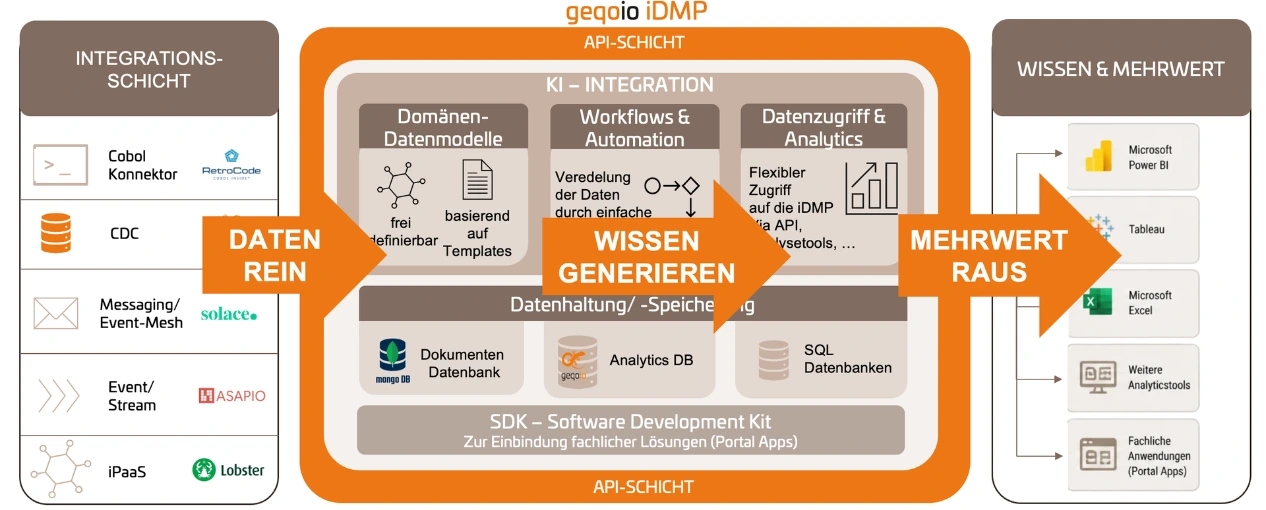
Architecture principle
iDMP is based on:
- Change Data Capture
- Event streaming mechanisms
- Central real-time data hub
- Standardized APIs
- Integration into Data Warehouse, Data Lake and
- Analytics platforms
The design is scalable, modular and
designed for enterprise environments.
Why RetroCode
"RetroCode combines deep COBOL expertise with modern architecture competence.
We understand both the stability requirements of mission-critical core systems and the demands of modern data platforms.
iDMP is the result of this experience:
A platform that does not replace legacy systems – but safely leads them into the future."

If we have piqued your interest, book today:
- Schedule an executive briefing
- Request an RDH discovery workshop
- Book a technical deep-dive conversation
- Start a migration risk analysis
iDMP makes legacy data immediately usable – without changing the legacy.